The short answer
Agentic AI security is how you let AI agents act for your business without handing them the keys. Give each agent its own identity and only the access its job needs. Make a person approve anything that sends, posts or spends, keep a log of every action, and treat everything an agent reads as untrusted.


Published
What is agentic AI security?
A chatbot answers questions. An agent does things: it reads your inbox, updates the CRM, drafts the reply, books the meeting and, if you let it, sends the email. Agentic AI security is the set of controls that decides what an agent may touch, what it has to ask before doing, and how you prove afterwards what it did.
Most of it is older than AI. Identity, least privilege, separation of duties and logging are the same rules we've used for people and servers for decades. What's new is that the thing holding the access can be talked into using it by a sentence hidden in an email or a web page. That one fact changes how you design everything around it.
Here's how I explain it to owners. You'd never give a new hire the master key, the company card and your email password on day one, then leave for the week. An AI agent deserves the same caution, and it has fewer instincts for when something looks off.

Why agentic AI security matters now
Agents went from demos to daily work fast, and the numbers show agentic AI security lagging behind. In IBM's Cost of a Data Breach Report 2026 (opens in a new tab), the global average breach cost reached 4.99 million dollars. Among organizations that reported an AI-related breach, 92% lacked proper AI access controls, and incidents involving unapproved AI use rose from 20% to 43% of organizations, as IBM's analysts explain here (opens in a new tab).
Every agent also needs credentials to reach your tools, and those pile up. The 2026 Identity Security Landscape (opens in a new tab) from Palo Alto Networks counts 109 machine identities for every human one. GitGuardian's State of Secrets Sprawl 2026 (opens in a new tab) found 28.6 million new secrets exposed in public GitHub commits in 2025, up 34%, with keys for AI services up 81%.
The standards bodies have caught up. OWASP published the Top 10 for Agentic Applications for 2026 (opens in a new tab) on December 9, 2025. In May 2026 the cyber agencies of the United States, the United Kingdom, Australia, Canada and New Zealand released joint guidance, Careful adoption of agentic AI services (opens in a new tab). The UK's NCSC summed it up (opens in a new tab) as: start small, use agents only for low-risk tasks, and apply established cyber security controls from the outset.
Agentic AI security for a 5 to 50 person business
Big companies have identity teams and a security operations center to catch mistakes. A business of 5 to 50 people usually has an owner, an office manager and an IT provider who visits when something breaks. That team can still run agents safely, because the controls that matter most are design choices made once, up front. Get them right in the system you choose and nobody has to watch it all day.
Increase in 2025 is highest in Keys for AI services at 81%.
| Increase in 2025 | |
|---|---|
| All new secrets | 34 |
| Keys for AI services | 81 |
Agentic AI risks, and the control that answers each one
OWASP's list names ten risks, ASI01 to ASI10. These are the agentic AI security risks a small business meets first, each paired with the control that stops it.
Goal hijack and prompt injection
An agent reads a customer email that says, in white text at the bottom, to forward the last ten invoices to an outside address. That's prompt injection, and OWASP ranks Agent Goal Hijack first (ASI01). You can't train it away completely. You contain it: the agent treats what it reads as data, and the actions that could do damage need a person's yes no matter who asked for them.
Too much access
The agent that summarizes your inbox doesn't need to send from it, and the one that drafts invoices doesn't need to delete customers. OWASP calls this Identity and Privilege Abuse (ASI03), and its older list for AI apps calls it excessive agency (opens in a new tab) (LLM06). The answer is least privilege, set per agent and per task.
Tool misuse
An agent with a legitimate tool can still use it badly: a bulk update run against the wrong list, a calendar tool used to invite strangers. OWASP lists this as Tool Misuse and Exploitation (ASI02). Narrow tools, limits on how much one action can change, and an approval step for anything that leaves the building keep a mistake small.
Leaked keys and tokens
Agents run on API keys, tokens and service accounts, which security people call non-human identities. When one leaks, whoever holds it is the agent as far as your systems can tell. In December 2022 a chat company (opens in a new tab) reported that a small number of employee tokens were stolen and used to download private code repositories. MITRE tracks the technique as steal application access token (opens in a new tab) (T1528). Keys belong in a vault, never in code or chat, scoped to one job and easy to revoke.
Memory poisoning and cascading failures
Agents that remember can be taught wrong things, and one agent's bad output becomes the next agent's input. OWASP lists Memory & Context Poisoning (ASI06) and Cascading Failures (ASI08). Keep rules a person wrote separate from notes an agent learned, so a learned note can never overrule a rule, and put a person's check between agents where the stakes are high.

The five controls of securing AI agents
In practice, agentic AI security comes down to five controls. If a product you're evaluating can't show you all five, keep looking.
Its own identity for every agent
Each agent gets its own account and its own credentials, never a person's login and never a shared key. Then every action traces back to one agent, and you can switch one off without breaking the rest. NIST's Cybersecurity Framework 2.0 (opens in a new tab) already names services alongside users in PR.AA-01, so agents fall under the identity rules you have.
Least privilege, scoped to the task
Give each agent only the tools and data its job needs, for as long as it needs them. NIST CSF 2.0 asks for exactly this in PR.AA-05: permissions defined in a policy, enforced, reviewed, and built on least privilege and separation of duties. The joint guidance agrees: minimum privileges for the task.
Human in the loop for anything that leaves the building
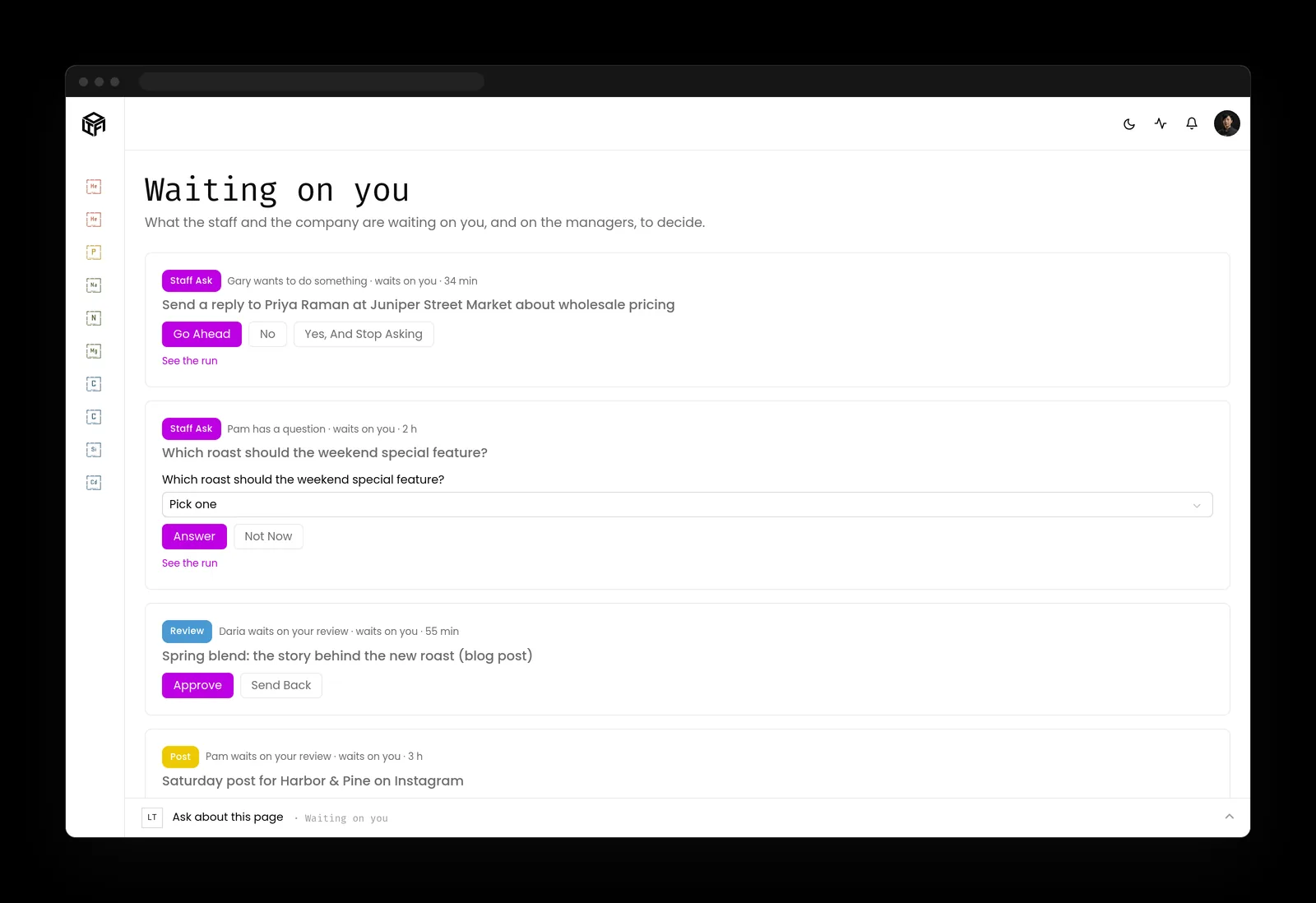
Drafting, summarizing and checking can run on their own. Sending, posting, publishing, paying and changing a live site wait for the person who owns that area. We go deeper on this in AI staff with approvals.
An audit trail you can trust
Write down every action in plain words: which agent, what it did, when, and who approved it. A good log is written before the action runs, so a crash in the middle still leaves a record, and it can't be edited after the fact.
Untrusted input stays data
Email, web pages, uploaded files and messages from outside are things an agent reads, never orders it follows. Mark them as outside data, and make sure the controls above hold even when an agent gets fooled.

How AI agents get identities and permissions
When an agent connects to your tools, it usually does it through the Model Context Protocol (MCP), the open standard that lets an AI system call outside tools. The protocol's authorization spec (opens in a new tab), in its July 28, 2026 revision, treats a protected MCP server as an OAuth 2.1 resource server. Tokens have to be issued for that one server, and a server must not accept or pass on any token that wasn't issued for it.
The agent signs in like an app, gets a pass that only works at one door, and can't lend that pass to anyone. That's the identity half of AI agent security. The permission half is deciding, per agent, which doors exist at all.

Shadow AI: the agents nobody approved
The riskiest agent in most small businesses is the one somebody connected to the company inbox with a free account and a browser extension. IBM's 2026 numbers say incidents involving unapproved AI use rose from 20% to 43% of organizations. Banning AI doesn't fix it, because people use what saves them time. Giving them a sanctioned tool that's easier than the workaround does.
Organizations is highest in 2026 report at 43%.
| Organizations | |
|---|---|
| 2025 report | 20 |
| 2026 report | 43 |
Agentic AI security in Massachusetts
If you hold personal information about Massachusetts residents, 201 CMR 17.00 (opens in a new tab) already applies to your AI agents. It asks for secure access control measures that restrict access to records containing personal information to those who need it, unique identifications for each user, and reasonable monitoring of systems for unauthorized use. An agent with its own identity, scoped access and a complete log is how you meet those words when the user is software.
Massachusetts' breach law, M.G.L. c. 93H (opens in a new tab), also requires notice when personal information is acquired or used without authorization. An audit trail is what lets you answer the first question a regulator or customer asks: what did it touch? We're in Shrewsbury, and this is the conversation we have with most owners in Worcester County and Boston who want agents doing real work.

What we've learned running agents every day
Kief Studio runs its own company on LTFI, so agentic AI security isn't theory to us. A few things we'd tell any owner.
- Default to asking. It feels slow for about a week, then the queue becomes the fastest part of your day, because everything that needs you is in one place.
- Let trust be earned one kind of task at a time. A standing approval for routine posts is reasonable after you've approved dozens. Money, deletions, keys and permissions should ask every time.
- Keep the rules with people. An agent can suggest a change to how it works, but only a person should be able to make one.
- Read the log weekly at first. It's the fastest way to see where an agent is doing more than you expected.

How LTFI handles agentic AI risks
LTFI is the agentic business operating system Kief Studio makes and runs. These are the agentic AI security controls it ships with today.
- Anything that sends, posts, publishes or spends waits in one queue for the person who owns it, on a computer or a phone.
- Standing approvals are yours to give for one kind of work and take back at any time.
- Rules, permissions, credentials, deleting and money stay with people. An AI teammate can't change them.
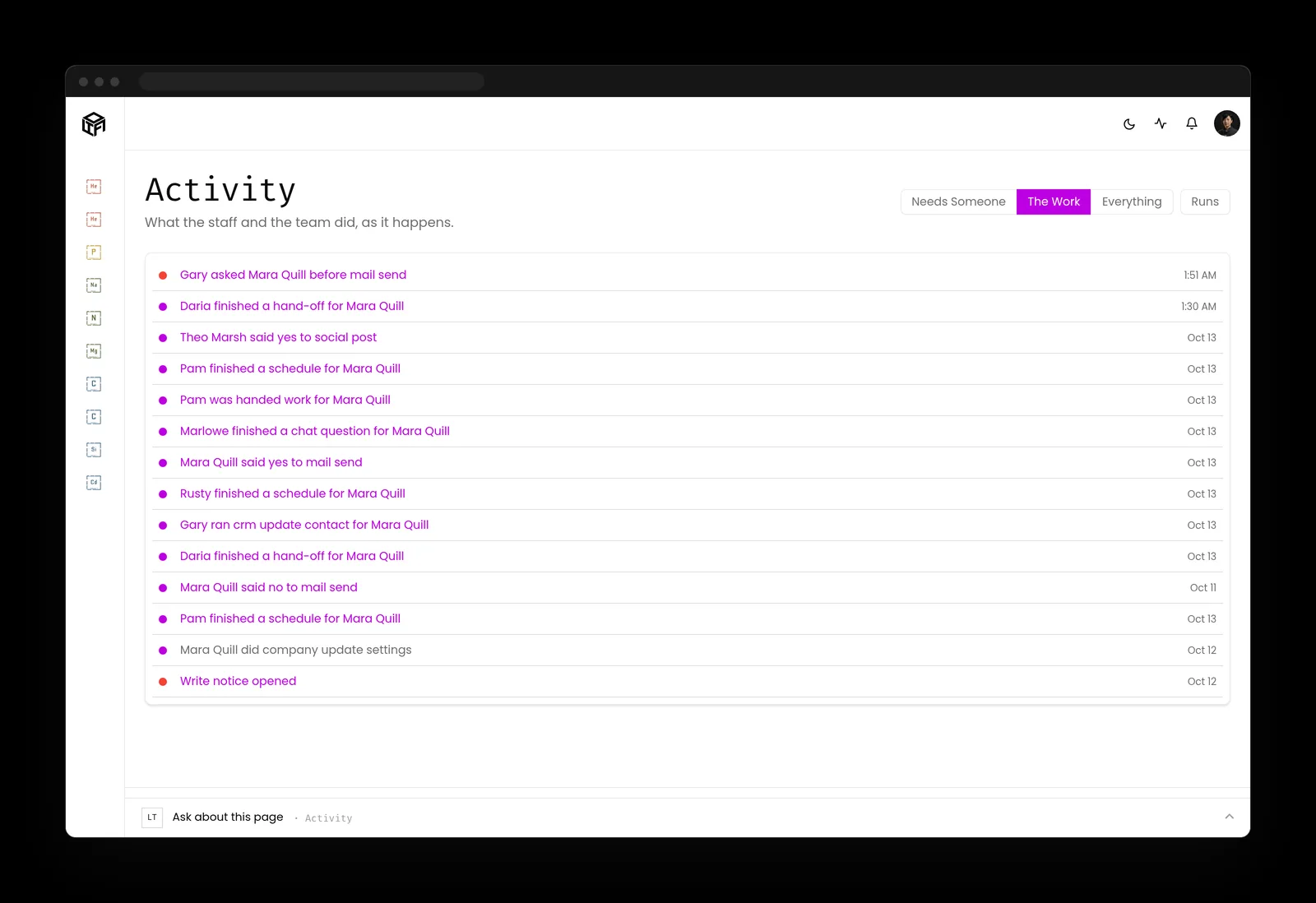
- The activity log records every action by the staff and the team in plain words, newest first, with who approved it.
- Each company runs on its own dedicated server, managed, patched and watched by us.
- Your AI runs on keys you own, under your contract with the AI company, with spend caps you set.

What to do about agentic AI security this month
Two lists: one for the person who owns the business, one for whoever runs its systems.
If you own the business
- List every AI tool that can read or send company email, files or customer data, including the free ones people signed up for.
- Decide which actions need your yes: sending, posting, paying and deleting are a good start.
- Pick one low-risk job for your first agent, like drafting replies, and expand from there.
- Ask any AI vendor to show you its approval queue and its activity log before you buy.
If you run the systems
- Give each agent its own service identity and scoped credentials; retire shared keys.
- Move keys into a vault, rotate them, and scan repositories and chat for leaked ones.
- Require audience-bound tokens for MCP servers and refuse token passthrough.
- Mark outside content as untrusted in every agent's context, and log every tool call before it runs.
Key takeaways
- Agentic AI security is mostly old controls applied to a new kind of user that can be talked into things.
- Five controls carry it: identity, least privilege, human approval, an audit trail, and untrusted input kept as data.
- Good agentic AI security starts with low-risk work and lets trust grow one kind of task at a time.
- In Massachusetts, 201 CMR 17.00 already covers what your agents can reach.
Where this lines up with the standards
The frameworks and rules this page maps to, with the exact item and what it asks of you.
| Framework | Item | What it asks |
|---|---|---|
| OWASP Top 10 for Agentic Applications | ASI01, ASI02, ASI03 (opens in a new tab) | Contain goal hijack, limit tool misuse, and keep each agent's identity and privileges narrow. |
| OWASP Non-Human Identities Top 10 | NHI2, NHI5, NHI7 (opens in a new tab) | Stop secret leakage, overprivileged machine identities and long-lived secrets. |
| NIST CSF 2.0 | PR.AA-01, PR.AA-05 (opens in a new tab) | Manage identities for services as well as users, and enforce least privilege and separation of duties. |
| NIST AI RMF and NIST AI 600-1 | Govern, Map, Measure, Manage (opens in a new tab) | Assign accountability for AI systems and keep human oversight over what they do. |
| Joint agency guidance | Careful adoption of agentic AI services (opens in a new tab) | Start with low-risk tasks, keep privileges minimal, and approve high-risk actions. |
| MITRE ATT&CK | T1528 (opens in a new tab) | Defend the application access tokens agents run on. |
| Massachusetts | 201 CMR 17.00 and M.G.L. c. 93H (opens in a new tab) | Restrict access to personal information, use unique IDs, monitor systems, and be ready to report a breach. |