


The short answer
Agentic IAM and AI SOC are where the 2026 security predictions land for a small business. Agentic IAM means every AI agent gets its own identity and only the access its job needs. AI SOC means AI agents help watch for attacks. Both work when a person stays accountable for what the agents do.


Published
At a glance
Every year brings a stack of 2026 security predictions, and most of them are written for companies with a security department. Two of this year's land on small businesses too.
- Agentic identity and access management: AI agents now hold logins, keys and tokens, and they need the same identity rules as people, plus a few new ones.
- The AI SOC: security teams are handing alert triage and first response to AI agents. Gartner's Hype Cycle for Security Operations, 2025 (opens in a new tab) reports that 42% of cybersecurity leaders said their organizations were piloting or using AI agents for threat detection and response, and another 46% planned to turn them on the following year.
- The gap: in IBM's Cost of a Data Breach Report 2026 (opens in a new tab), 92% of organizations that reported an AI-related breach lacked proper AI access controls.
Cybersecurity leaders is highest in Planning to turn them on the following year at 46%.
| Cybersecurity leaders | |
|---|---|
| Piloting or using AI agents | 42 |
| Planning to turn them on the following year | 46 |
Why these two predictions belong together
I spend a lot of my week with owners who want AI to take work off their plate, and the question I hear most is some version of: who's responsible when it gets something wrong? That question sits under agentic IAM and AI SOC alike.
Agentic IAM decides what an agent is allowed to do. An AI SOC decides who notices when an agent, or an attacker using one, does something it shouldn't. One without the other leaves a hole. Strong identity with nobody watching means mistakes go unseen. Watching without identity means you can see something happened but can't say which agent did it or on whose authority.
The machine side is growing faster than the human side. The 2026 Identity Security Landscape (opens in a new tab) from Palo Alto Networks counts 109 machine identities for every human one. In a business of twenty people, that's a lot of logins nobody is thinking about.

What agentic IAM and AI SOC mean in practice
Strip the acronyms and both are about people staying in charge of software that can act.
Agentic IAM: an identity for every agent
Identity and access management (IAM) is how a business decides who can get into what. Agentic IAM extends it to AI agents. Each agent gets its own account, never a borrowed employee login. It gets only the permissions its job needs, for as long as it needs them. And its credentials can be switched off in one place without breaking anything else.
None of this is exotic. NIST's Cybersecurity Framework 2.0 (opens in a new tab) already covers services in PR.AA-01 and asks for least privilege and separation of duties in PR.AA-05. The new part is that an agent can be persuaded by what it reads, so its permissions have to assume it will be fooled sometimes.
AI SOC governance: agents that watch, people who decide
A security operations center (SOC) is the team that watches for attacks and responds. An AI SOC uses agents to sort alerts, gather evidence and suggest what to do. Done well, it means a small IT provider can watch more clients more closely. AI SOC governance is the set of rules that decides which steps an agent may take on its own, like collecting logs, and which need a person, like locking an account or wiping a laptop.
Agentic IAM and AI SOC for a small business
You probably don't run a SOC, and you don't need to. Your IT provider or MSP might, and the agents in your own tools need identities either way. Your job is to ask the right questions and choose systems where the answers are built in.

How it goes wrong, step by step
Here's the chain we design against, with the control that breaks each link.
- An attacker hides an instruction in an email or a shared document. The control: the agent treats outside content as data, never as orders.
- The agent, fooled, tries to forward files or send a payment. The control: anything that leaves the business waits for a person's approval.
- The attacker tries to reuse the agent's token somewhere else. The control: tokens work at one service only and can't be passed on, as the MCP authorization spec (opens in a new tab) requires.
- Someone asks later what happened. The control: an activity log written before each action, showing which agent did what and who approved it.

The quiet risk is shadow AI
The most common gap I see isn't a sophisticated attack. It's an employee who connected a free AI tool to the company inbox to save an hour a day. IBM's analysts report (opens in a new tab) that security incidents involving unapproved AI use rose from 20% to 43% of organizations.
People reach for those tools because they work. Telling a team to stop rarely does much. Giving them an approved tool that's just as easy, with the guardrails already on, tends to end the workarounds within a few weeks.

Our analysis
We run our own company on LTFI, with AI staff doing real work every day, so we've had to answer these questions for ourselves first. Three things stand out.
- The approval queue matters more than the model. Which AI you use changes week to week. Where the yes happens, and who gives it, is what protects you.
- People relax once the rules are visible. Owners who can see exactly what waits for them, and who approved what, stop worrying about the AI and start delegating more to it.
- Accountability has to name a person. A log that says an agent did something is half the story. The other half is the name of whoever said yes.

What this signals for next year
Expect buyers to ask vendors the questions security teams ask today: does each agent have its own identity, what can it do without asking, and can I see the log? The joint guidance from the US, UK, Australian, Canadian and New Zealand cyber agencies, Careful adoption of agentic AI services (opens in a new tab), already says to start with low-risk tasks and require human approval for high-risk actions. Businesses that build that way now won't have to rebuild later.

How LTFI handles agentic IAM and AI SOC questions
LTFI is the agentic business operating system Kief Studio makes and runs. These controls ship with it today.
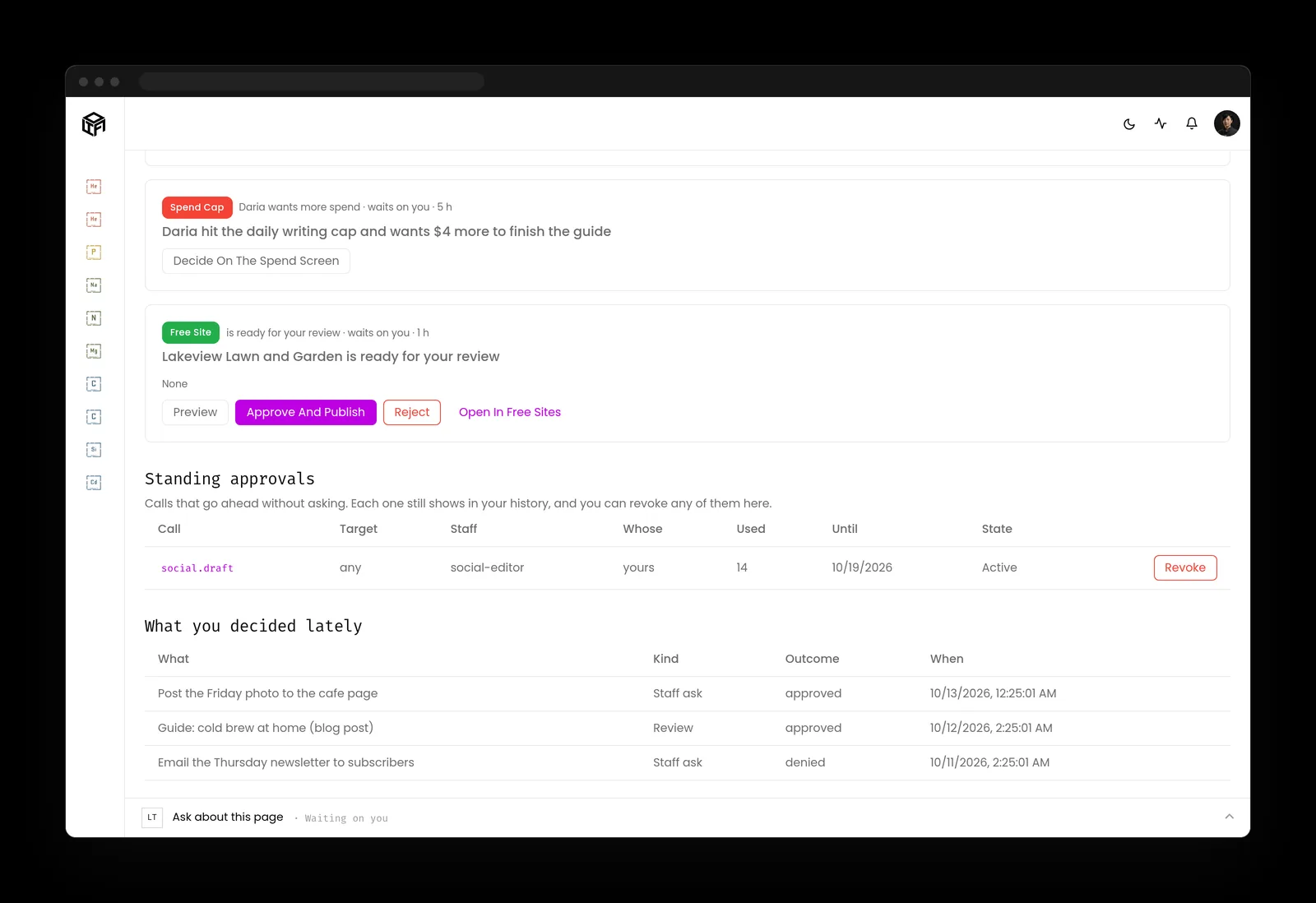
- Anything that sends, posts, publishes or spends waits for the person who owns it.
- Standing approvals are given for one kind of work and taken back at any time.
- Rules, permissions, credentials, deleting and money stay with people.
- The activity log shows every action by the staff and the team, and who approved it.
- Your company runs on its own dedicated server, managed, patched and watched by us.

What to do next
Two lists: one for the person who owns the business, one for whoever runs its systems.
If you own the business
- Ask your team which AI tools they use for work, and make it safe to answer honestly.
- Write down the actions you want to approve yourself.
- Ask your IT provider whether they use AI agents to watch your systems, and which actions those agents can take without a person.
- Choose one approved AI tool with approvals and a log, so the workarounds have somewhere better to go.
If you run the systems
- Inventory machine identities: API keys, tokens, service accounts and the agents using them.
- Give every agent its own identity with scoped, short-lived credentials.
- Define which SOC actions an agent may take alone and which need a person, and write it down.
- Send agent actions to the same log as human ones, with the approver recorded.
Key takeaways
- Agentic IAM and AI SOC are two halves of one job: knowing what each agent can do, and noticing when something goes wrong.
- Every agent needs its own identity, scoped access and credentials you can switch off.
- Decide which actions an agent may take alone and which wait for a person, before you need the answer.
- Shadow AI is the most common gap, and a better approved tool closes it faster than a ban.
Where this lines up with the standards
The frameworks and rules this page maps to, with the exact item and what it asks of you.
| Framework | Item | What it asks |
|---|---|---|
| OWASP Top 10 for Agentic Applications | ASI03 Identity and Privilege Abuse; ASI09 Human-Agent Trust Exploitation; ASI10 Rogue Agents (opens in a new tab) | Keep agent identity and privileges narrow, guard against misplaced human trust, and catch rogue agents. |
| OWASP Non-Human Identities Top 10 | NHI1 Improper Offboarding; NHI5 Overprivileged NHI; NHI10 Human Use of NHI (opens in a new tab) | Offboard unused identities, cut overprivilege, and stop people using machine identities. |
| NIST CSF 2.0 | PR.AA-01, PR.AA-05 (opens in a new tab) | Manage identities for services and enforce least privilege and separation of duties. |
| Joint agency guidance | Careful adoption of agentic AI services (opens in a new tab) | Phase in autonomy, limit privileges to what the task needs, and keep human oversight and logging. |
| Massachusetts | 201 CMR 17.00 (opens in a new tab) | Unique IDs, access limited to need, and reasonable monitoring for unauthorized use. |
