
The short answer
An AI SOC uses AI agents to do the reading in security operations: sorting alerts, pulling in context and writing up what happened. Let agents investigate. Keep the actions that change things, like containing a machine, locking an account, deleting data or closing an incident, with a person who approves each one.


Published
The AI SOC at a glance
Security teams drown in alerts, and most of those alerts turn out to be nothing. Reading them is slow, repetitive work, and it's exactly the kind of work AI agents are good at. That's the whole pitch of the AI SOC, and it's a fair one, as long as you're careful about where the reading stops and the acting starts.
- Adoption is coming fast. Gartner's Hype Cycle for Security Operations, 2025 (opens in a new tab) reports that 42% of cybersecurity leaders said their organizations were piloting or using AI agents for threat detection and response, and another 46% planned to turn them on the following year.
- The standards already split the work. NIST's Cybersecurity Framework 2.0 (opens in a new tab) puts analysis under Detect (DE.AE) and the actions that change things, like containment, under Respond (RS.MI).
- The cyber agencies of the United States, the United Kingdom, Australia, Canada and New Zealand published Careful adoption of agentic AI services (opens in a new tab) on May 1, 2026. It says to begin with low-risk tasks, limit an agent's privileges to the minimum its task needs, and keep high impact actions behind prior human approval.
- OWASP's Top 10 for Agentic Applications (opens in a new tab) names the ways it goes wrong, from Agent Goal Hijack (ASI01) to Human-Agent Trust Exploitation (ASI09).
Share of cybersecurity leaders is highest in Planning to turn them on the following year at 46%.
| Share of cybersecurity leaders | |
|---|---|
| Piloting or using AI agents | 42 |
| Planning to turn them on the following year | 46 |
What an AI SOC is, and where the agents fit
A security operations center (SOC) is the team, in-house or at your IT provider, that watches your systems for attacks and responds when something looks wrong. Most small businesses don't have one of their own. If you have a managed or co-managed SOC through your IT provider, you have one, and it's worth knowing how they use AI inside it.
What is an AI SOC?
An AI SOC is a security operations center where AI agents do the first pass on alerts. An agent reads the alert, gathers the logs and context around it, decides how likely it is to be real, and writes a summary a person can act on. A good AI SOC is faster at the boring part and leaves the decisions where they were.
Agentic SOC versus the automation you already have
Security teams have run automation for years: a playbook that blocks a known bad address, a rule that opens a ticket. Those follow fixed steps a person wrote. An agentic SOC is different because the agent chooses its own next step. It decides which logs to pull, which tool to call and what to conclude. That flexibility is the value, and it's also why the old rules about who may act need writing down again.

What to let AI SOC agents investigate
Here's the work I'm comfortable handing to agents. Each one reads, sorts or writes, and none of it changes your systems. If an agent gets one of these wrong, a person catches it at the next step and nothing is broken.
Alert triage
Alert triage is deciding which alerts matter. NIST CSF 2.0 calls it out in RS.MA-02 (incident reports are triaged and validated) and RS.MA-03 (incidents are categorized and prioritized). An agent can sort a thousand alerts into likely, unlikely and needs a look, with its reasons. A person still reviews what it set aside, at least for the first few months.
Enrichment
Enrichment means adding context: who owns the laptop, what else that account did this week, whether the address is on a threat list. That's DE.AE-03 (information is correlated from multiple sources) and DE.AE-07 (threat intelligence and other context are integrated into the analysis). Agents are quick at it. Give them read access to the sources they need and nothing more.
Summaries and timelines
The most useful thing an AI SOC agent writes is the timeline: what happened, in order, with the evidence for each step. That serves RS.AN-03, analysis that establishes what took place and the root cause. A clear summary also makes the person approving the next step faster and better at it.
Drafts for people to send
An agent can draft the ticket, the note to the account owner and the first version of an incident report. The send stays with a person, because RS.CO-02 (stakeholders are notified of incidents) is a decision with legal weight, and in Massachusetts it can trigger notice duties under M.G.L. c. 93H.

What an AI SOC agent must never do alone
These are the actions that change the world: they stop people working, remove evidence or end an investigation. In an AI SOC, an agent may propose every one of them, with its reasons. A named person approves before any of them runs.
Containment
Isolating a machine, blocking a network range or shutting a service down is RS.MI-01 (incidents are contained). In a real attack it's the right move. When the alert is false, it causes an outage. An agent that can contain on its own can be tricked into taking your own business offline. Let it prepare the containment step so a person can approve it in one click.
Account lockouts and password resets
Locking an account during payroll week or forcing a reset on the owner's phone during a client meeting causes real harm when the alert was wrong. An attacker who knows an agent locks accounts automatically can also use that to lock out whoever they want. Lockouts and resets wait for a person.
Deleting data or wiping devices
Deletion can't be undone, and it destroys the evidence an investigation needs. NIST asks that incident data be collected with its integrity and provenance preserved (RS.AN-07). No agent should hold the right to delete files, mail or devices during incident response. If something has to go, a person decides, after the evidence is copied.
Closing an incident
Declaring an incident (DE.AE-08) and deciding it's over (RS.MA-05, the criteria for starting recovery) are judgment calls. An agent that can close its own tickets can quietly bury the one that mattered. On a well-run team, an agent recommends closing and a person signs off, with their name on the record.

How an AI SOC goes wrong, step by step
Here's the chain we design against, with the control that breaks each link.
- An attacker plants text where the triage agent will read it, such as an email subject or a log line telling the agent this activity is approved maintenance. OWASP calls this Agent Goal Hijack (ASI01). The control: the agent treats alert content as data, and its verdict never closes anything on its own.
- The fooled agent tries to act, blocking the wrong address or locking the wrong account. OWASP calls this Tool Misuse and Exploitation (ASI02). The control: response tools sit behind an approval step, and the agent's identity can only read.
- A tired analyst approves whatever the agent recommends. OWASP names this Human-Agent Trust Exploitation (ASI09): people approving actions without checking. The control: the approval shows the evidence and the effect of the action, and high impact steps get a second look.
- One wrong conclusion feeds the next agent in the chain. OWASP calls it Cascading Failures (ASI08). The control: a person checks the hand-off where the stakes are high, and every step is logged so the bad link can be found.
Planted text (ASI01)
An attacker plants text where the triage agent will read it, and the control is that the agent treats alert content as data.
The agent acts (ASI02)
The fooled agent tries to block or lock the wrong thing, and the control is an approval step in front of response tools.
A tired approval (ASI09)
An analyst approves whatever the agent recommends, and the control is an approval that shows the evidence and the effect.
The error spreads (ASI08)
One wrong conclusion feeds the next agent, and the control is a person checking the hand-off where the stakes are high.

AI SOC governance: the rules to write down
AI SOC governance is the written answer to one question: which steps may an agent take alone, and which wait for a person? The joint agency guidance is clear on this. Decisions about when human approval is required should be set by the system's designers or operators and not delegated to the agent itself. Write these down before you switch anything on.
- An action list in tiers: read and summarize (agent alone), draft and propose (agent, reviewed by a person), change or delete (person approves every time).
- A named approver for each tier, with a backup for nights and holidays.
- Its own identity for each agent, with read access by default and short-lived credentials for anything more.
- A log of every action the agents take during an investigation, kept so it can't be edited, which is what RS.AN-06 asks for.
- A weekly sample of alerts the agent marked as harmless, read by a person, so you know how often it's wrong.
- A switch that turns an agent off in one place without touching the rest of your monitoring.
Read and summarize
The agent may do this alone.
Draft and propose
The agent does this and a person reviews it.
Change or delete
A person approves every time.

What we've learned running AI agents with approvals
We run Kief Studio on LTFI, our own agentic business operating system, with AI staff doing real work every day. My wife Amelia, our CEO, reviewed this page, and the rule we both hold to is simple: anything that leaves the building waits for a person. LTFI isn't a SOC. The lessons from running it carry over directly.
- The queue gets faster with use. When an agent hands you a clear summary and one button, approving takes seconds. Most of the time saved comes from the reading, and the decision itself stays quick.
- Trust grows one kind of task at a time. We give a standing approval only after we've approved the same kind of action many times, and we take it back the moment something looks off.
- The log is where you learn. Reading what the agents did each week shows exactly where they reach further than you expected.
An AI SOC for a small business
You probably won't build an AI SOC yourself. You'll buy one inside a managed or co-managed service, or your IT provider will add one without telling you. Either way, the questions are the same, and you're entitled to answers.
Massachusetts gives you a reason to ask. 201 CMR 17.00 (opens in a new tab) requires reasonable monitoring of systems for unauthorized use of personal information, and an AI SOC can help you meet it. The decision to notify under M.G.L. c. 93H stays yours, with your lawyer, never an agent's.

How LTFI handles the AI SOC rule of reading versus acting
LTFI isn't a SOC, and we don't sell it as one. It runs AI staff for the rest of your business on the same rule: agents read and draft freely, and people approve what acts. These controls ship today.
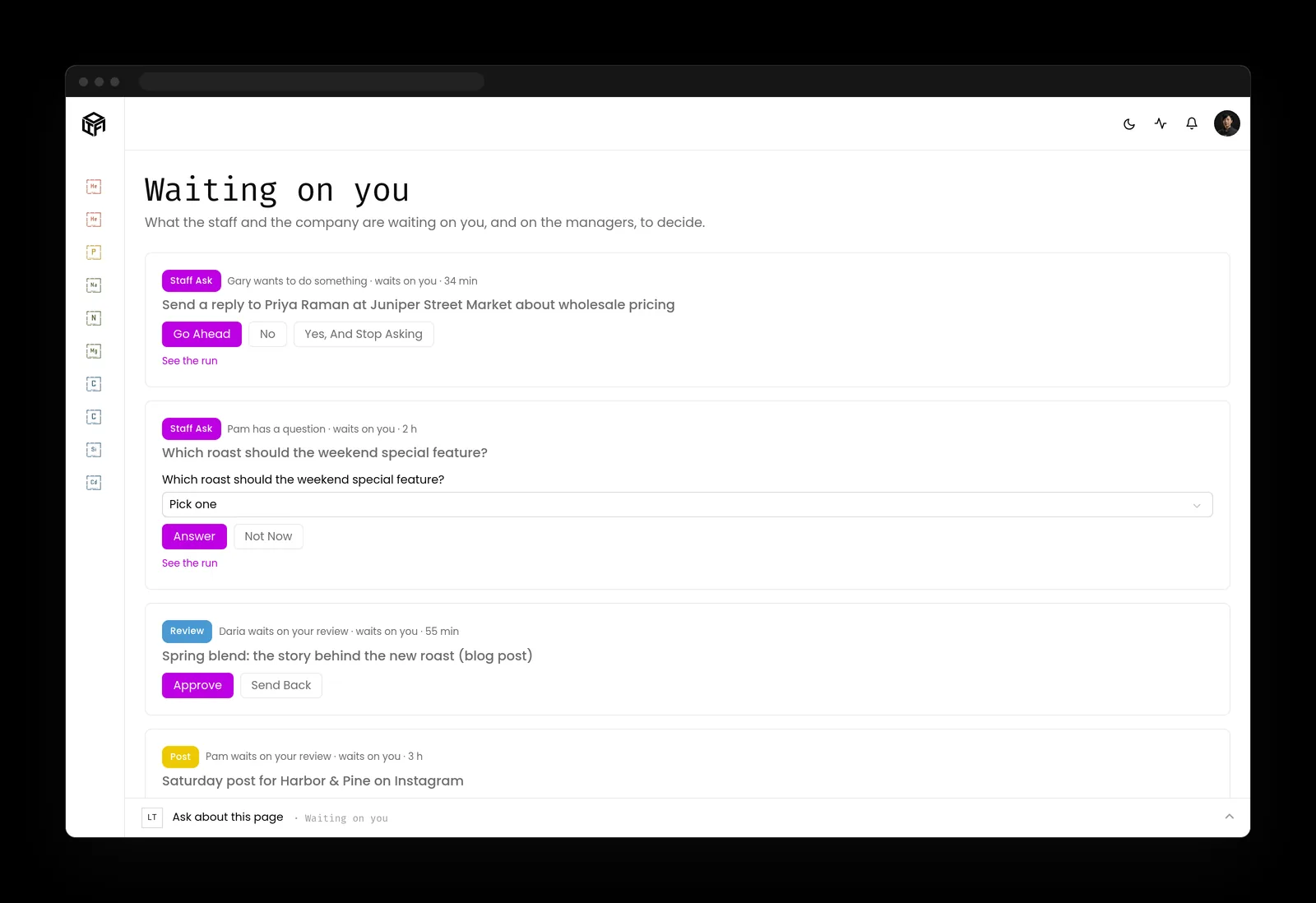
- Anything that sends, posts, publishes or spends waits in one queue for the person who owns it, on a computer or a phone.
- Standing approvals are yours to give for one kind of work and take back at any time.
- Rules, permissions, credentials, deleting and money stay with people. An AI teammate can't change them.
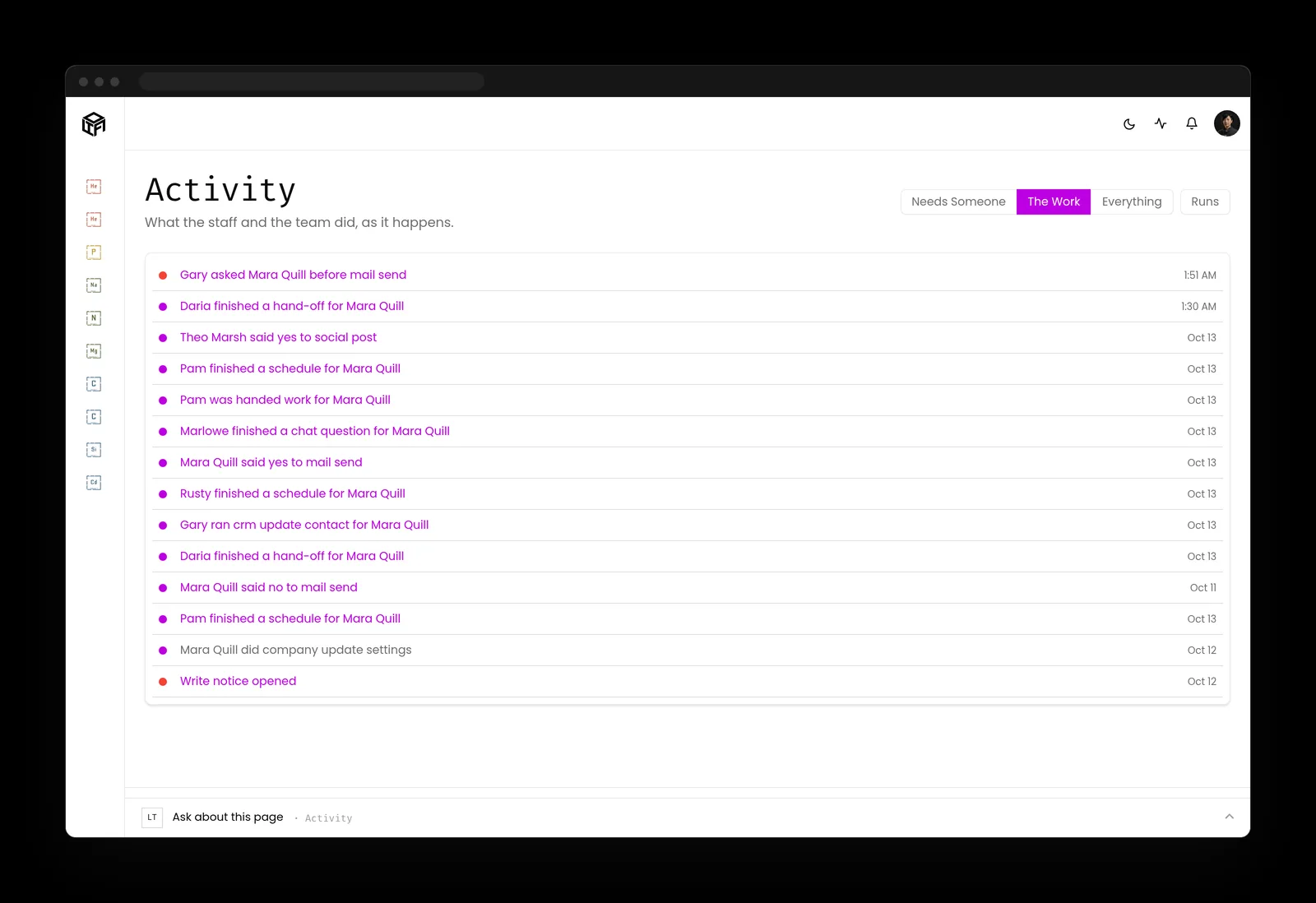
- The activity log records every action by the staff and the team in plain words, newest first, with who approved it.

What to do about your AI SOC this month
Two lists: one for the person who owns the business, one for whoever runs its systems.
If you own the business
- Ask your IT provider whether AI agents watch your systems, and which actions those agents can take without a person.
- Ask who approves containment, lockouts and deletions, and how fast they can be reached.
- Ask to see a sample of the summaries the agents write, and an entry from the action log.
- Write down who in your business makes the call to notify customers after an incident.
If you run the systems
- Sort every AI SOC tool into read, propose and act, and put the act tier behind an approval step.
- Give each agent its own identity with read-only access by default and short-lived credentials for the rest.
- Treat alert content, email and logs as untrusted input in every agent's context.
- Log agent actions alongside human ones, with the approver recorded, and sample agent-closed alerts weekly.
Key takeaways
- An AI SOC is worth having for the reading: alert triage, enrichment, timelines and drafts.
- Containment, lockouts, deletion and closing incidents stay with a named person, every time.
- AI SOC governance starts as a written list of what an agent may do alone, decided by people.
- Every agent action belongs in a log you can't edit, with the approver's name on it.
Where this lines up with the standards
The frameworks and rules this page maps to, with the exact item and what it asks of you.
| Framework | Item | What it asks |
|---|---|---|
| NIST CSF 2.0, Detect | DE.AE-02, DE.AE-03, DE.AE-07, DE.AE-08 (opens in a new tab) | Analyze and correlate events with context, and declare incidents against defined criteria. |
| NIST CSF 2.0, Respond | RS.MA-02, RS.AN-06, RS.AN-07, RS.MI-01 (opens in a new tab) | Triage and validate reports, record investigation actions, preserve evidence, and contain incidents. |
| NIST SP 800-61 Rev. 3 | Incident response as a CSF 2.0 Community Profile (opens in a new tab) | Build incident response into everyday risk management, organized by the CSF 2.0 Functions. |
| OWASP Top 10 for Agentic Applications | ASI01 Agent Goal Hijack; ASI02 Tool Misuse and Exploitation; ASI08 Cascading Failures; ASI09 Human-Agent Trust Exploitation (opens in a new tab) | Contain goal hijack, gate tool use, stop failures spreading, and guard against approving on trust. |
| Joint agency guidance | Careful adoption of agentic AI services (opens in a new tab) | Start with low-risk tasks, keep privileges to the minimum, and require prior human approval for high impact actions. |
| Massachusetts | 201 CMR 17.00 and M.G.L. c. 93H (opens in a new tab) | Monitor systems for unauthorized use of personal information, and notify when a breach occurs. |