
The short answer
The OWASP Agentic Top 10 is the OWASP list of the ten biggest security risks for AI agents, ASI01 to ASI10, published December 9, 2025. It runs from agent goal hijack to rogue agents. Most of the risks come back to three controls: narrow access, a person's approval for actions that matter, and a log of everything.


Published
The OWASP Agentic Top 10 at a glance
If you're letting AI agents read your email, update your records or talk to customers, this is the list to know. OWASP is the nonprofit foundation behind widely used software security lists, and its agentic list is written for AI that acts.
- The full name is the OWASP Top 10 for Agentic Applications for 2026 (opens in a new tab), from the OWASP GenAI Security Project, published December 9, 2025.
- It names ten risks, ASI01 to ASI10, each with examples and a list of mitigations.
- It builds on OWASP's list for AI apps. Its idea of excessive agency (opens in a new tab) (LLM06) becomes several separate agentic AI risks once the AI can act on its own.
- Government guidance points the same way. The joint paper from the cyber agencies of five countries, Careful adoption of agentic AI services (opens in a new tab), published May 1, 2026, says to start with low-risk tasks, keep privileges to the minimum a task needs, and require human approval before high impact actions.
How to read the OWASP Agentic Top 10 as an owner
The OWASP document is written for the people who build agents, and it's long. You don't need to read it all. You need to know what each risk looks like in a business like yours, and what to ask whoever sets up your AI.
What is the OWASP Agentic Top 10?
The OWASP Agentic Top 10 is a ranked list of the ways AI agents get misused or go wrong, with a code for each one, from ASI01 to ASI10. Security teams use the codes to talk about risks the same way, and vendors use them to show which risks their controls answer. When a vendor tells you their product covers the OWASP Agentic Top 10, ask them to show you the control for each code.
Why it's a separate list
OWASP's older list covers AI that answers questions. An agent plans, calls tools, remembers and hands work to other agents, so the damage from one bad input is bigger and lasts longer. The agentic list covers those new paths. Below, each risk gets its official name, an example from a small business and the control that answers it.
The older list
OWASP's older list covers AI that answers questions.
The agentic list
The agentic list covers agents that plan, call tools, remember and hand work to other agents.
ASI01: Agent Goal Hijack
OWASP's description rests on a hard fact: agents can't reliably tell the instructions they were given apart from the content they read. An attacker uses that to change what the agent is trying to do.
The example: your inbox agent reads a supplier's email. Hidden in white text at the bottom is an instruction to forward the last ten invoices to an outside address. The agent was asked to summarize, and now it's trying to send.
The control: treat everything an agent reads from outside as data, give it only the tools its job needs, and put a person's approval in front of anything that sends, pays or deletes. You won't stop every hijack attempt. You can make sure a hijacked agent can't do much.

ASI02: Tool Misuse and Exploitation
Here the agent stays inside the permissions it was given, and uses a legitimate tool in a harmful way. OWASP's own example is an email summarizer that can delete or send mail without confirmation.
The example: a bookkeeping agent with a bulk update tool runs a price change against every customer instead of one, or a scheduling agent sends a calendar invite to a list it scraped from a document.
The control: narrow tools (read the inbox, without the send button), limits on how much one action can change, and a confirmation step for anything destructive or outward. OWASP's mitigations name exactly this: least privilege for each tool and human confirmation for high-impact actions like delete, transfer and publish.

ASI03: Identity and Privilege Abuse
This is the risk of agents borrowing access they shouldn't have: a person's login, a cached token, or the permissions of another agent that handed it work. OWASP says that without a distinct identity of its own, an agent can't be held to least privilege at all.
The example: the owner signs an assistant into their own email account so it can help with replies. Now the assistant can do anything the owner can, including reach the bank's password reset emails.
The control: every agent gets its own identity and its own credentials, scoped to its task and short-lived where possible. NIST's Cybersecurity Framework 2.0 (opens in a new tab) asks for this in PR.AA-05, with permissions defined in a policy, enforced, reviewed, and built on least privilege and separation of duties.

ASI04: Agentic Supply Chain Vulnerabilities
Agents load parts from other people: models, tools, plug-ins, datasets, other agents and tool servers that speak the Model Context Protocol. OWASP points out that agents often pick these up while running, so a poisoned part can arrive after you've checked everything else.
The example: someone on your team installs a free plug-in that promises to connect the AI to your accounting software. Its tool description carries hidden instructions, and every agent that loads it inherits them.
The control: a short, approved list of tools and plug-ins, pinned to known versions, with a person reviewing anything new before an agent can use it. Tool servers you connect should follow the MCP authorization spec (opens in a new tab), which treats a protected server as an OAuth 2.1 resource server and forbids it from passing tokens on.

ASI05: Unexpected Code Execution (RCE)
Many agents write and run code to get things done. If an attacker can steer what that code says, they can run their own commands on the machine the agent lives on. RCE stands for remote code execution, which is about as bad as security problems get.
The example: a reporting agent writes a small script to clean up a spreadsheet a customer sent. A cell in the spreadsheet carries instructions that turn the script into one that copies files off the computer.
The control: code that agents write runs in a locked-down sandbox, never as an administrator, with no access to the network or your files beyond what the job needs. Running anything outside that box needs a person's approval.
ASI06: Memory & Context Poisoning
Agents that remember things between tasks can be taught wrong things. OWASP describes attackers seeding an agent's memory or the documents it searches with false or misleading information, so later decisions go wrong long after the attack.
The example: a customer service agent keeps notes on each account. A message from an attacker gets saved as a note that says this customer's refunds are pre-approved. Weeks later, the agent acts on it.
The control: keep the rules a person wrote separate from the notes an agent learned, so a learned note can never overrule a rule. Record where every memory came from, and let people review and remove what agents have saved.

ASI07: Insecure Inter-Agent Communication
When agents pass work to each other, those messages need the same protection as any other business traffic. If they aren't authenticated and checked, an attacker can read them, change them or pretend to be one of the agents.
The example: a sales agent hands a quote to an invoicing agent. Something in between changes the amount or the bank details, and the invoicing agent has no way to tell.
The control: agents prove who they are to each other, messages are protected in transit and checked before anyone acts on them, and hand-offs that move money or data go through the same approval step as everything else.
ASI08: Cascading Failures
One error, passed from agent to agent, grows as it spreads. OWASP is careful to say this risk is about how the first mistake spreads, whether it started as a hallucination, a bad input or a poisoned memory, until it does damage across several systems.
The example: a research agent gets a figure wrong, a writing agent builds a customer email around it, and a scheduling agent sends it to your whole list.
The control: checkpoints between agents where the stakes are high, limits on how fast and how far one run can act, and a log of each step so the bad link can be found and the chain stopped.
ASI09: Human-Agent Trust Exploitation
This one is about people. Agents sound confident and helpful, and people trust them. OWASP describes attackers using that trust to get a person to approve something harmful, so the person performs the final action and the agent's part stays hidden.
OWASP's own example fits a small business exactly: a poisoned vendor invoice goes into a finance assistant, the assistant suggests an urgent payment to the attacker's bank details, and the finance manager approves it.
The control: an approval screen that shows the evidence and the exact effect of the action, and leaves the agent's sales pitch out. Payments, bank detail changes and anything irreversible get checked against a source the agent didn't supply.

ASI10: Rogue Agents
A rogue agent has drifted away from what it was meant to do, through compromise, a bad setup or a slow slide in behavior. Each action may look reasonable on its own, while the pattern does harm.
The example: an outreach agent meant to follow up with warm leads slowly widens who it emails, until it's sending to people who never asked to hear from you.
The control: OWASP's mitigations include an audit log that can't be edited, monitoring for unusual actions, and a kill switch that disables an agent and revokes its credentials at once. Read the log weekly at first, so you see the drift before your customers do.

Which OWASP Agentic Top 10 risks a small business meets first
We run Kief Studio on LTFI, with AI staff doing real work every day, and my partner Amelia reviewed this page. From running it ourselves, three entries on the OWASP Agentic Top 10 come up first in a small business.
- Identity and Privilege Abuse (ASI03) shows up on day one, because the easy way to connect an assistant is to sign it in as yourself. Give it its own account instead.
- Agent Goal Hijack (ASI01) follows as soon as an agent reads outside email. The answer is an approval step on anything that leaves the building.
- Human-Agent Trust Exploitation (ASI09) grows as you get comfortable. The more you trust an agent, the more an approval screen needs to show you the facts and keep the pitch out.
ASI03 on day one
Identity and Privilege Abuse shows up first, because the easy way to connect an assistant is to sign it in as yourself.
ASI01 with outside email
Agent Goal Hijack follows as soon as an agent reads outside email, and the answer is an approval step on anything that leaves the building.
ASI09 as trust grows
Human-Agent Trust Exploitation grows as you get comfortable, so the approval screen needs to show the facts and keep the pitch out.
How LTFI answers the OWASP Agentic Top 10
LTFI is the agentic business operating system Kief Studio makes and runs. These controls ship with it today, and each one answers several of the codes above.
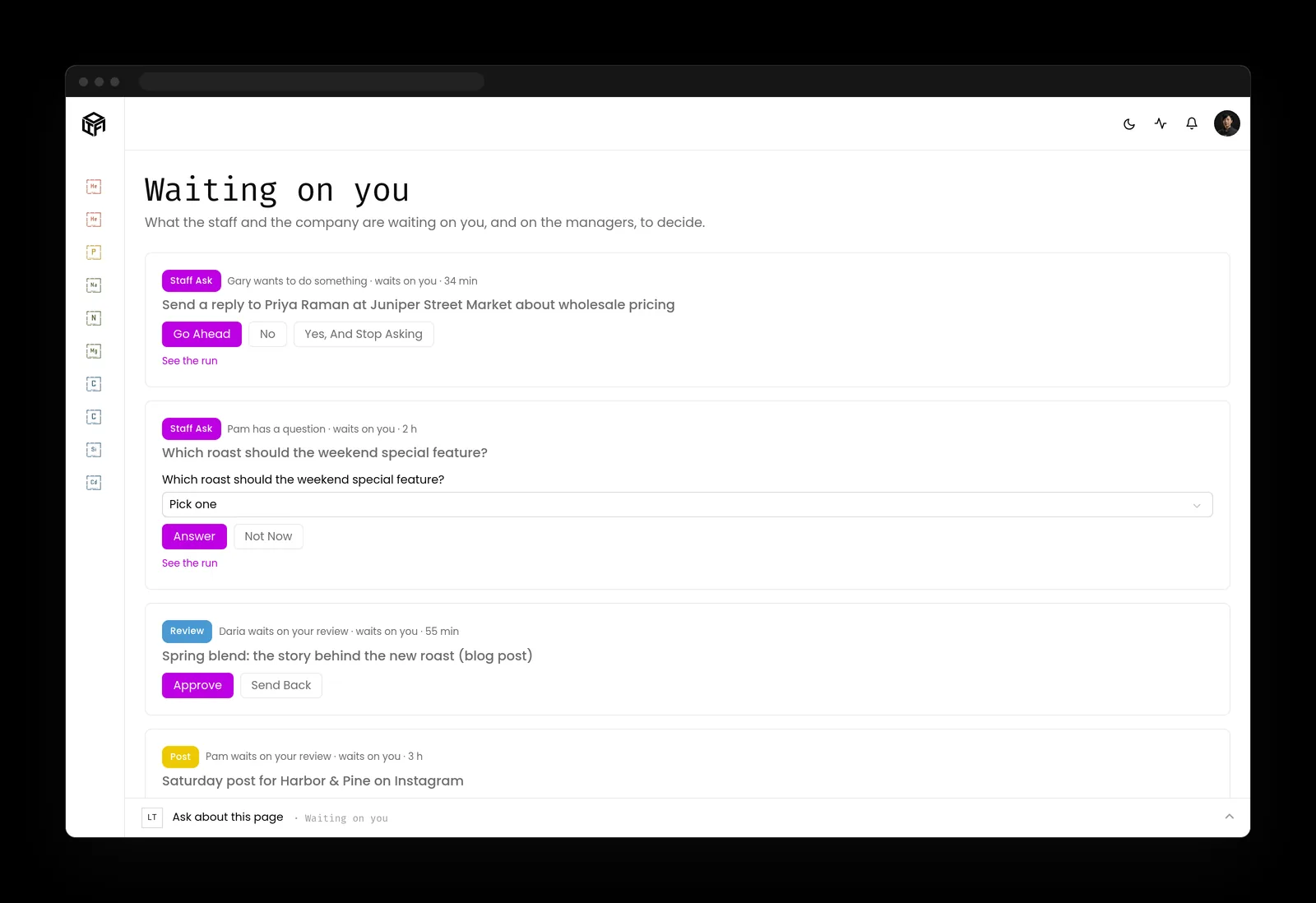
- Anything that sends, posts, publishes or spends waits in one queue for the person who owns it (ASI01, ASI02, ASI08).
- Rules, permissions, credentials, deleting and money stay with people, and an AI teammate can't change them (ASI03, ASI10).
- A new skill is saved as a draft, and AI staff don't use it until a person approves it (ASI04).
- Standing approvals cover one kind of work you chose, stay visible, and can be taken back at any time (ASI09, ASI10).
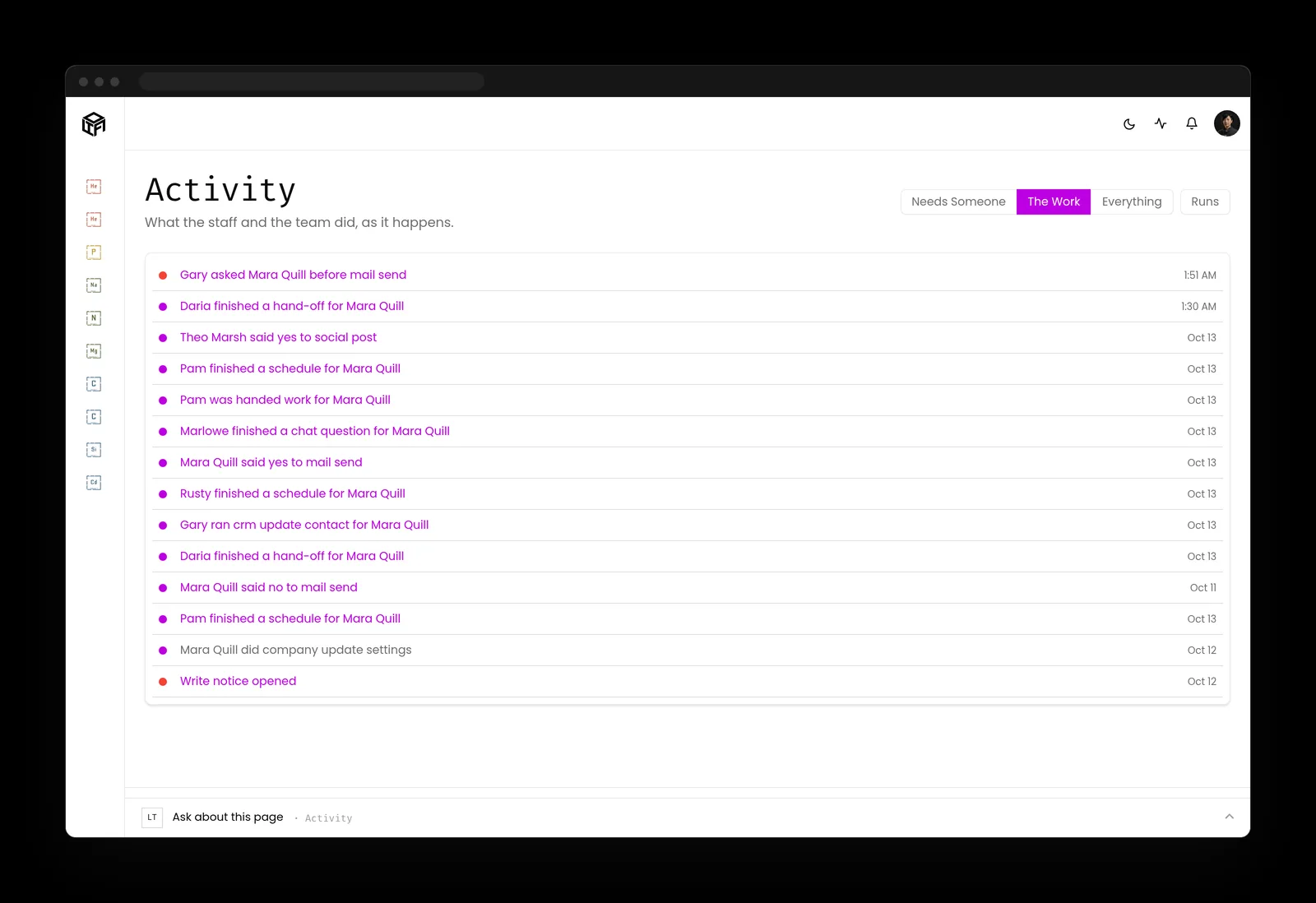
- The activity log records every action by the staff and the team in plain words, newest first, with who approved it (ASI08, ASI10).
What to do with the OWASP Agentic Top 10
Two lists: one for the person who owns the business, one for whoever runs its systems.
If you own the business
- List the AI tools that can read or send company email, files or customer data, and who signed each one in.
- Make sure no assistant is signed in as you. Give each one its own account.
- Decide which actions need your yes: sending, paying, deleting and changing bank details are a good start.
- Ask any AI vendor to show you, code by code, how they handle ASI01 to ASI10.
If you run the systems
- Give each agent its own identity with scoped, short-lived credentials, and retire shared keys.
- Keep an approved list of tools, plug-ins and MCP servers, pinned to versions, and review anything new.
- Run agent-written code in a sandbox with no network access by default.
- Keep a log of every agent action that can't be edited, with a kill switch that revokes an agent's credentials in one step.
Key takeaways
- The OWASP Agentic Top 10 names ten risks, ASI01 to ASI10, for AI that can act.
- Most of the list is answered by three controls: narrow access, a person's approval for actions that matter, and a complete log.
- Every agent needs its own identity. Signing an assistant in as yourself is the most common mistake.
- Approvals only protect you if the screen shows the facts, because ASI09 is about people trusting agents too easily.
Where this lines up with the standards
The frameworks and rules this page maps to, with the exact item and what it asks of you.
| Framework | Item | What it asks |
|---|---|---|
| OWASP Top 10 for Agentic Applications | ASI01 to ASI10 (opens in a new tab) | Name and control the ten agent-specific risks, from goal hijack to rogue agents. |
| OWASP Top 10 for LLM Applications | LLM06 Excessive Agency (opens in a new tab) | Limit an AI system's functionality, permissions and autonomy to what its job needs. |
| NIST CSF 2.0 | PR.AA-05, PR.PS-04 (opens in a new tab) | Enforce least privilege and separation of duties, and generate logs for continuous monitoring. |
| MCP authorization spec | OAuth 2.1 resource servers (opens in a new tab) | Bind tokens to one tool server and forbid passing them on. |
| Joint agency guidance | Careful adoption of agentic AI services (opens in a new tab) | Start with low-risk tasks, keep privileges minimal, and require approval for high impact actions. |
| Massachusetts | 201 CMR 17.00 (opens in a new tab) | Restrict access to personal information to those who need it, use unique IDs, and monitor for unauthorized use. |