

The short answer
Agentic operations means AI staff do a company's routine work every day, inside written rules, while people approve anything that leaves the business. Kief Studio built LTFI and runs its own company on it: drafts, follow-ups, posts, projects and reports run on AI staff, and every send, post, payment and client change waits for one of us.


Published
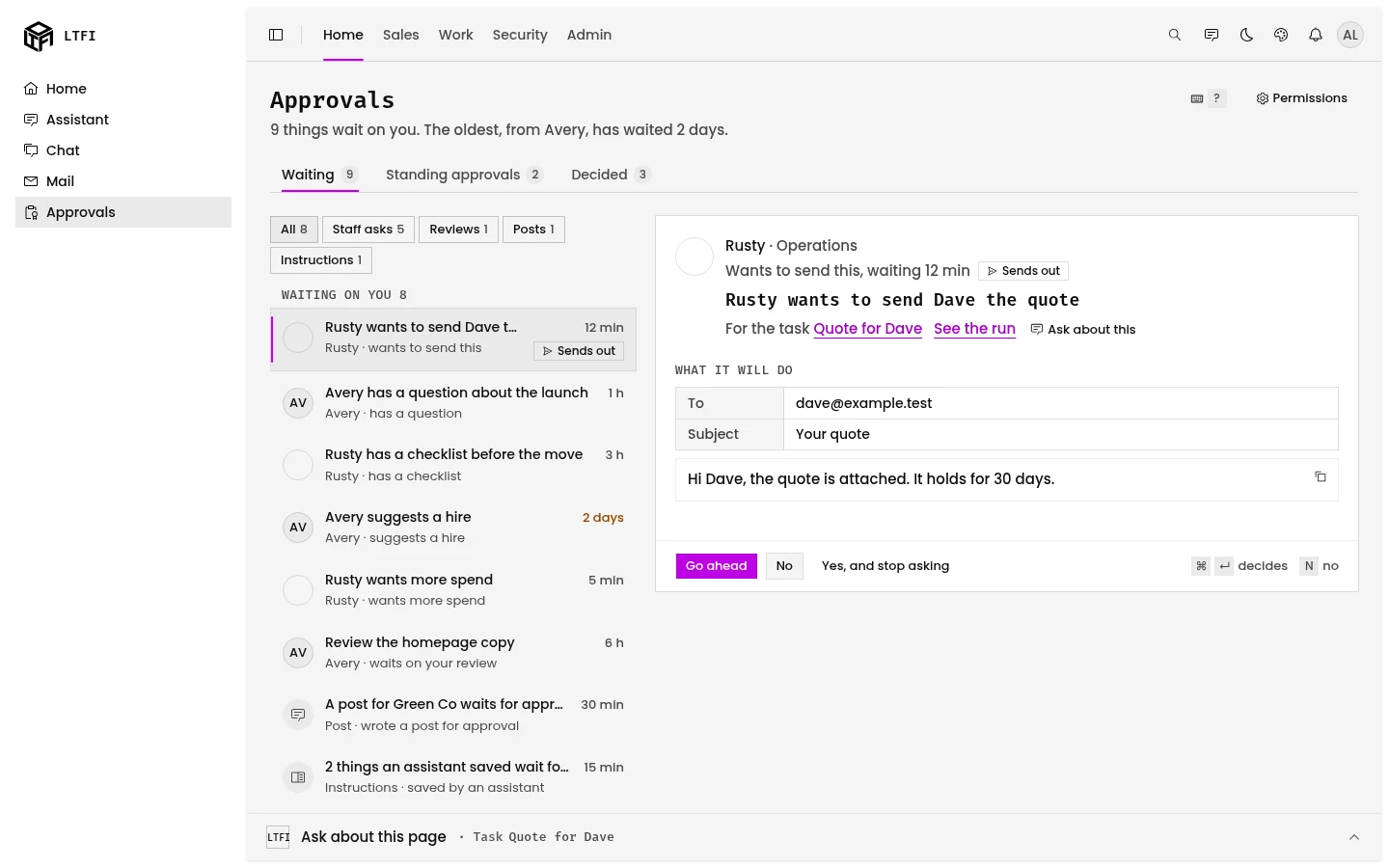
What agentic operations means
Agentic operations is the day-to-day running of a business with AI staff doing the routine work. They draft, sort, follow up, keep records current and prepare reports. People still own the decisions, and anything that reaches a customer or moves money waits for one of them.
We use the term the way an owner would: the operations of a business, run with agentic AI. It sits on top of what we call an agentic business operating system, the place where that work runs, with one memory of your customers and projects, written rules, approvals and a log.
Agentic operations for a business, not a data center
Search for agentic operations and you'll also find pages about running IT systems with AI: watching servers, closing alerts, fixing outages. That's a real field with its own tools. This page is about something closer to home for most owners: the follow-ups, the invoices, the posts and the weekly report.
Why Kief Studio built LTFI
Amelia and I founded Kief Studio in Shrewsbury, Massachusetts, in 2022, and I've consulted on technology since 2006. For years we watched good businesses, ours included, buy one more tool and then one more, until nobody could see the whole picture. Every tool had a little AI in it, and none of them knew what the others had done.
So we built one system for the whole business and put AI staff inside it that ask before they act. We ran our own company on it before we offered it to anyone else. That's the order we'd recommend to any team trying agentic operations: use it on your own work first, where you'll notice every rough edge. The short version of the story is on our about page.
What runs on agentic operations at Kief Studio
Here's what agentic operations looks like inside our own company: what our AI staff actually do, day to day, and where each job stops for one of us. None of it is exotic. It's the work that used to sit between us and the work clients pay for.
- Content: AI staff research and draft articles for our own sites and for clients' sites, with charts and pictures. A person reads every one, and nothing publishes on a client's site without a person's approval.
- Social posts: drafts are lined up for each brand in its own voice. Each brand's approver says yes before anything posts.
- Follow-ups: the AI drafts replies and reminds us who has gone quiet. One of us approves anything that goes to a person outside the company.
- Projects and tasks: the task lists stay current, and the weekly summary is written for us.
- The morning brief: each of us starts the day with what needs us today and what happened since yesterday.
- Reports: the numbers for our sites and clients are pulled each week and explained in plain words.
Runs on its own
Research, drafting, sorting, summaries, keeping records current and preparing reports.
Waits for one of us
Sending, posting, publishing, client messages, spending, scheduling and any change to a client's site.

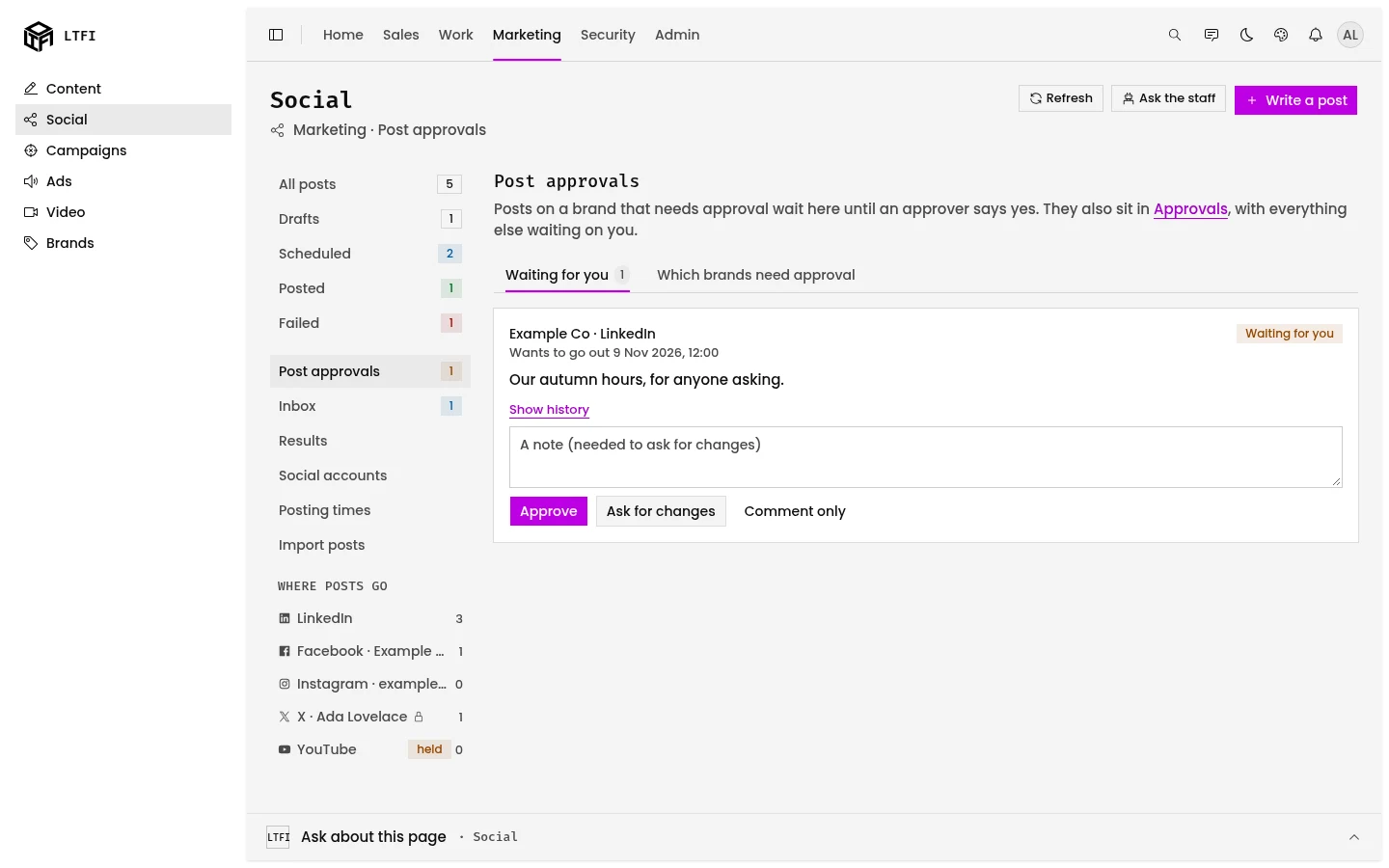
The rules we wrote before anything ran
Agentic operations is only as safe as the rules underneath it, so we wrote ours down first. The joint guidance from the cyber agencies of Australia, the United States, Canada, New Zealand and the United Kingdom, Careful adoption of agentic AI services (opens in a new tab), says to prevent agents from autonomously executing high impact actions without prior human approval. We drew our lines the same way.
- Without asking: briefs, summaries, research, monitoring, answers and drafts.
- Ask first and wait for a yes: posting, sending mail or outreach, publishing, client messages, spending, scheduling, and changes to client sites.
- Only a person, ever: rules and instructions, who approves what, permissions, credentials, deleting and money.
Why the default in agentic operations is to ask
When we weren't sure where a job belonged, it went in the ask-first list. Loosening one kind of work later is easy. Explaining to a client why an AI sent something they never saw is not. The OWASP Top 10 for Agentic Applications (opens in a new tab) calls the failure we're guarding against tool misuse, and its advice is human confirmation for high-impact actions such as delete, transfer and publish.
What changed for us
We won't put a number on our own results from agentic operations; we're one company, not a study. What we can describe is how the week feels different.
- The blank page is gone. Most mornings start with drafts waiting for a read, not a list of things to write.
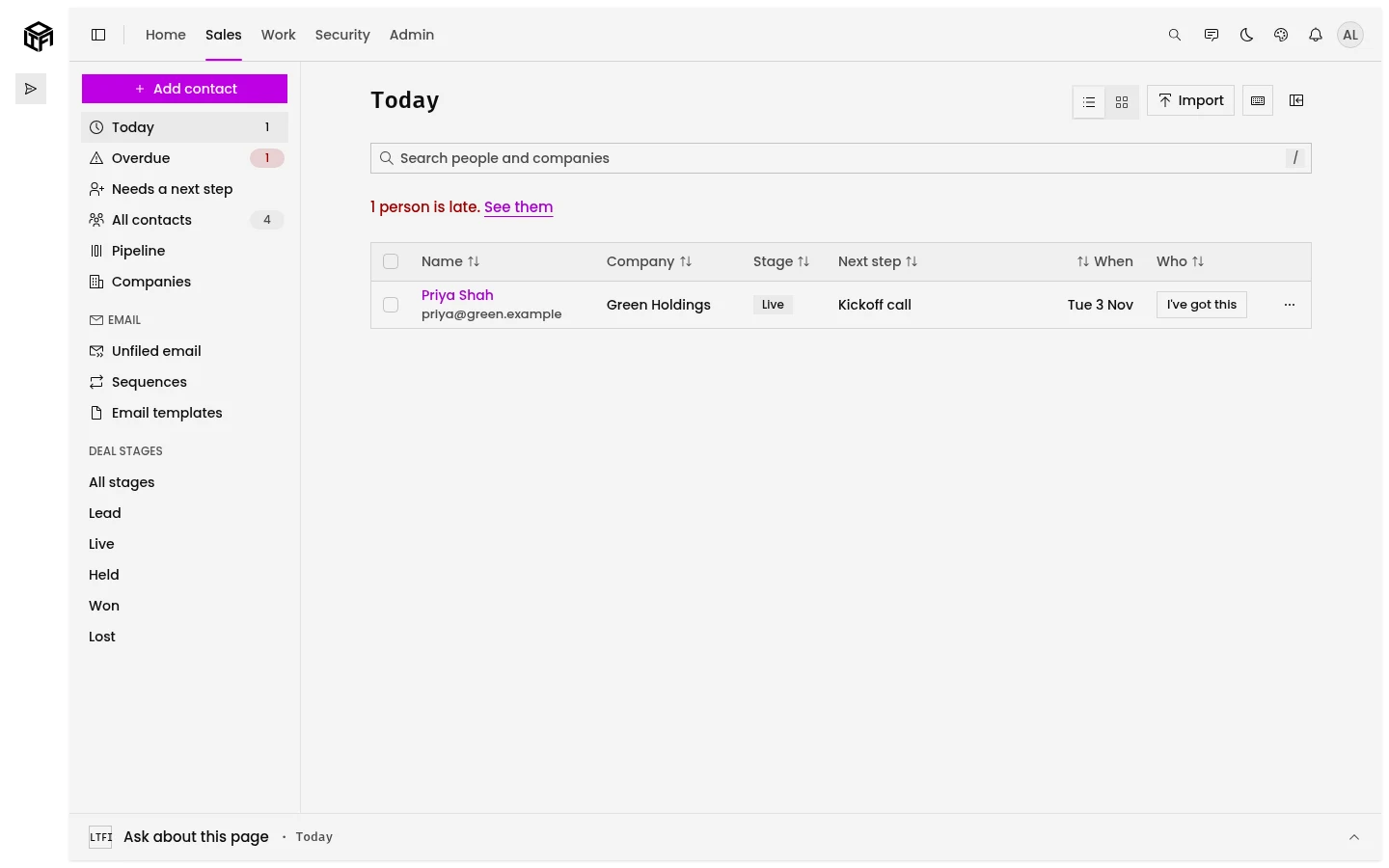
- Approvals arrive in one queue. We answer them sooner because nobody has to remember which app a draft is in.
- Writing a rule once works. When we decide what every press release must include, every AI teammate follows it from then on.
- The log is how we tune the work. When the same kind of draft keeps getting sent back, the fix is usually a clearer instruction, and the log shows us which one.
Where agentic operations still needs a person
In agentic operations, judgment calls stay with people: what to say to a client who's upset, which project comes first, whether a post fits the moment. The AI staff make those calls easier by having the facts ready. They don't make them for us.

What the data says about AI at small companies
Our experience of agentic operations is one company's. The surveys on small business AI give the wider picture, and it lines up with what we've seen: AI at small firms mostly speeds up the work people already do.
The Federal Reserve Banks' 2026 Report on Employer Firms (opens in a new tab), based on the 2025 Small Business Credit Survey, found that 46% of small employer firms said the business or its employees used AI. Among those firms, the most common uses were writing or marketing at 83%, individual productivity at 61% and planning or analysis at 51%. Asked what changed, 71% said productivity went up, 39% reported better quality and 31% reported higher sales, while most saw no change in labor costs.
AI users expect to hire, not cut
The Federal Reserve Bank of New York looked at the same survey in AI Adoption and Employment Expectations (opens in a new tab), published on Liberty Street Economics in October 2026. Small businesses using AI had a 33 percentage point net expectation of higher employment over the next year, against 15 points for non-users, and a 48 point net expectation of higher revenue, against 21. The authors are careful to call these associations, not causes.
The Federal Reserve Bank of Minneapolis, writing about the Census Bureau's survey in AI adoption in business grows steadily but unevenly (opens in a new tab), reported that roughly 96% of companies using AI saw no change in employment, while 10 percent of AI-using firms said AI was now doing tasks employees used to do.
Firms using AI is highest in Productivity went up at 71%.
| Firms using AI | |
|---|---|
| Productivity went up | 71 |
| Quality of goods or services improved | 39 |
| Sales went up | 31 |
Hiring and revenue expectations, with and without AI
Here are the New York Fed's figures side by side. A net expectation is the share expecting an increase minus the share expecting a decrease, so a higher number means more owners expect growth.
Use AI is highest in Higher revenue at 48; Don't use AI is highest in Higher revenue at 21.
| Use AI | Don't use AI | |
|---|---|---|
| Higher employment | 33 | 15 |
| Higher revenue | 48 | 21 |
How we'd start agentic operations at another company
If you asked us to set up agentic operations for your business tomorrow, this is the order we'd follow, and it works the same whether you have AI agents from one vendor or several. It's the order we followed for ourselves.
Pick one routine job
Follow-ups or the weekly report are good first jobs: frequent, low risk and easy to check.
Write the rules
Decide what runs alone, what waits for a yes and what only a person may ever do, and name who approves each area.
Keep everything outward set to ask
Sending, posting, paying and client changes all wait for a person at the start.
Read the log weekly
See what was approved, sent back and left waiting, and fix the instructions behind the send-backs.
Add the next job
Once the first job runs cleanly for a month, add one more. Never several at once.
Agentic operations on LTFI for your business
LTFI is the agentic business operating system we built and use every day. For your company it runs the same way it runs ours: AI staff with real jobs, your rules, approvals in one queue that works on a phone, and an activity log of everything that happened. The page on AI staff with approvals shows how approvals work, and what LTFI does covers the rest.
Kief Studio hosts and runs it for you, so nothing is installed at your end. If you'd rather have the whole thing set up and looked after, Kief Studio's managed services (opens in a new tab) do that for small and mid-size businesses.
What to do this week if you're weighing agentic operations
Two lists: one for the person who owns the business, one for whoever runs its systems.
If you own the business
- Write down the five routine jobs that eat the most time each week.
- For each, decide what could run alone and what must wait for you or a named person.
- Pick one job to start with, and the date you'll review it.
- Ask any vendor to show you their approval screen and their log, live.
If you run the systems
- List every AI tool already connected to company accounts, including the ones staff added themselves.
- Give each AI teammate its own identity and only the access its job needs.
- Enforce approvals in the system that takes the action, not in the AI's instructions.
- Make sure every action and approval is logged with a time and a name, and that you can export it.
Key takeaways
- Agentic operations means AI staff do routine business work every day while people approve what leaves the business.
- Kief Studio built LTFI and runs its own company on it, with the same rules it sets up for clients.
- Write the rules first: what runs alone, what waits for a yes, and what only a person may ever do.
- The surveys show AI at small firms mostly raises productivity, and AI users expect to hire, not cut.
Where this lines up with the standards
The frameworks and rules this page maps to, with the exact item and what it asks of you.
| Framework | Item | What it asks |
|---|---|---|
| Joint agency guidance | Careful adoption of agentic AI services (opens in a new tab) | Require prior human approval for high-impact actions, and let people, not agents, decide where approval applies. |
| OWASP Top 10 for Agentic Applications | ASI02 Tool Misuse, ASI03 Identity and Privilege Abuse (opens in a new tab) | Confirm high-impact actions with a person and keep each agent's access to its job. |
| NIST AI RMF | Govern, Map, Measure, Manage (opens in a new tab) | Set policies and owners, know where AI acts, measure how well it does, and manage what you find. |
| NIST CSF 2.0 | PR.AA-05 access permissions (opens in a new tab) | Define, manage and review access with least privilege and separation of duties. |
| Massachusetts | 201 CMR 17.00 and M.G.L. c. 93H (opens in a new tab) | Restrict and monitor access to personal information, and be ready to report a breach. |